 ← All guides
Guide
Car Hire at Faro Airport: Deposits, Excess and What the Desk Will Offer You
By Selo · Published 20 July 2026 · Facts last verified 20 July 2026
Collecting a hire car at Faro Airport means one of three things: a desk inside the terminal, a short walk to the shared Park P4 rental village just outside, or a free shuttle to an office a few minutes down the road, and your booking confirmation will say which. Your card will be pre-authorised for a security deposit, and that hold is usually a few hundred euros but can run well into four figures depending on the car and the operator. The desk will then offer you an excess waiver and a list of extras, some genuinely useful, some you may already have covered another way. And one piece of good news: the A22, the Algarve's main motorway, has been toll-free since 1 January 2025, though hire cars still carry an electronic toll device for other Portuguese roads. None of this needs to be stressful if you know what's coming before you land.
How pickup actually works at Faro Airport
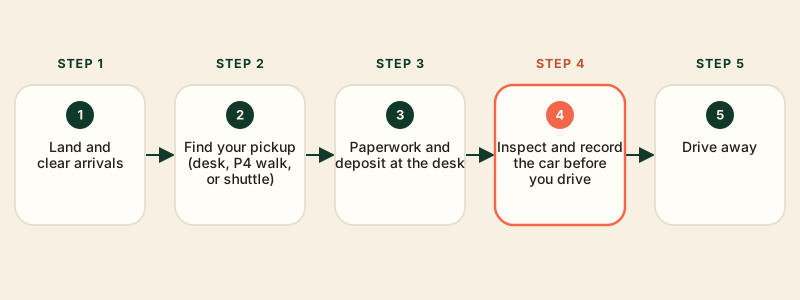
Faro is served by two kinds of car hire supplier, and where you go depends entirely on which one you booked with, not on price or how the company markets itself.
International brands such as Avis, Hertz, Europcar, Budget, Enterprise, Sixt and others maintain their own desks inside the terminal, right next to the arrivals area. You check in at the counter and staff walk you out to the company's own car park.
Local and smaller Portuguese operators share a facility called Park P4, about 250 metres from the terminal exit, on your left as you leave arrivals. There's a single customer service desk inside P4 shared between several companies, and staff there will walk you to your car once you've presented your booking. This is a legitimate, long-standing part of how Faro operates, not a downgrade, but it does mean a longer walk and a shared queue at busy times.
A third group of operators, mostly the cheaper off-airport firms, run a free shuttle bus from the terminal to an office a short drive away. Read your confirmation carefully here: a listing that says "Faro Airport" can still mean a shuttle transfer to a depot in town, which adds transfer time in each direction, so build that into your plans on arrival day and for the return.
Note that the "meet and greet" desk near arrivals is generally for private transfer and taxi services, not car hire pickup, so don't expect a driver holding your name unless your rental confirmation specifically says someone will meet you there.
The deposit and the excess: what actually gets held on your card
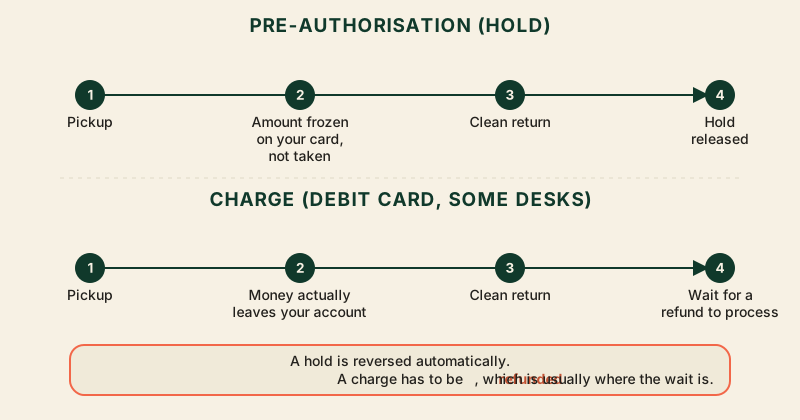
Almost every operator at Faro will ask for a credit card to secure a refundable pre-authorisation covering the excess, the maximum amount you're on the hook for if the car comes back damaged. A pre-authorisation is a hold, not a charge: the money isn't actually taken from your account, it's just blocked until the car is returned clean, and it should release fairly quickly once that happens.
The amount held varies enormously by car category and operator. Published examples for Faro range from around €200 for a small car with a low-deposit brand up to over €1,500, and in some cases beyond €3,000, for larger vehicles or lower-cost operators. Basic collision cover included in most rental contracts typically caps your liability at roughly €1,500, but it usually excludes damage to tyres, the windscreen and the underside of the car, which are only covered if you pay extra.
Debit cards work at many Faro operators too, but the mechanics change: rather than a hold, the excess amount is more likely to be taken as an actual payment, and getting it back can take noticeably longer than the near-instant release of a credit-card hold. Several operators also require you to buy their full waiver cover (sometimes marketed as Super CDW plus a supplementary policy) before they'll accept a debit card at all. If you're travelling on a debit card, check this before you book, not at the desk.
What the desk will offer you, and what you may already have
The educational point first: an excess waiver (sometimes called SCDW or Super CDW) reduces or removes your liability for the excess amount, usually for a daily fee added on top of your rental. It's a real product that does what it says, the question is only whether the desk's version is the cheapest way to get that cover.
Published rates give a sense of the range. One Faro-based operator's own terms list a collision-waiver upgrade priced by vehicle group, from around €10 a day for the smallest cars up to about €20 a day for larger ones. Broader UK market data suggests reducing your excess at the rental desk generally costs somewhere between £15 and £30 a day, and that a week of the full waiver package (collision cover plus tyre and windscreen cover) can add up to roughly £35 a day once averaged out. By comparison, standalone excess insurance bought independently before you travel starts from around £3.99 a day, or from about £42 for an annual policy covering multiple trips, and these policies commonly include the tyre, windscreen, roof and undercarriage cover that basic desk waivers exclude. Whether the desk waiver, an annual policy, or your own card's travel insurance is the better fit depends on how often you rent and how much a large pre-authorisation hold would worry you, but it's worth doing that maths before you're standing at the counter.
Other things commonly offered at the desk: a second driver, usually cheaper to add when you book online than in person, GPS or a child seat if you didn't book one, and fuel options. On fuel, "full to full" (you collect with a full tank and return it full) is widely recommended as the fairest policy, since a "full to empty" deal usually means you've prepaid for a full tank at the desk's rate and get nothing back for fuel left in the car. There's a petrol station roughly a minute's drive from the terminal, useful if you need to top up before returning the car, and it's worth keeping the receipt.
Tolls, fuel and the rules of the road
The headline change for anyone driving the Algarve in 2026: the A22 motorway, the Via do Infante, has been toll-free since 1 January 2025, after tolls were scrapped across several Portuguese motorways following years of local protest. You can use the A22 the length of the Algarve without paying a toll.
That doesn't mean the electronic toll device in your hire car is irrelevant. Since a 2023 change in the law, every rental company in Portugal must fit its cars with a Via Verde device, and the service is added to your contract automatically. It matters if you drive further afield, up towards Lisbon or elsewhere on the tolled national network, where the standard structure is a daily service fee (commonly cited around €2.21 a day, capped at roughly €22.14 per rental) on top of whatever tolls you actually use, refunded if you don't cross a single toll point. Ask at the desk how your specific operator bills it.
On the rules themselves: Portugal's drink-drive limit is 0.5 grams of alcohol per litre of blood, dropping to 0.2 g/l for drivers who have held a licence less than a set period. That is the same standard limit as Ireland and Scotland, and stricter than the 0.8 g/l limit in England, Wales and Northern Ireland, so treat "one drink and I'm fine" with caution. Irish licence holders don't need an International Driving Permit to drive in Portugal, an EU licence is valid on its own alongside your passport. UK licence holders don't need one either for a visit; a UK licence is accepted in Portugal without an IDP. Most operators at Faro require drivers to be at least 21 with at least two years held, and some add a young-driver surcharge below that or above 65, so check the age terms on your specific booking. Fuel currently runs at roughly €1.91 a litre for petrol and €1.85 for diesel across Portugal, though prices have been moving upward through late July 2026, so treat this as a snapshot rather than a fixed number.
Protecting yourself at pickup and at drop-off
The single most useful thing you can do at collection takes two minutes: walk around the car and photograph every panel, the wheels, the roof, the interior and the fuel gauge before you drive off, and make sure any existing mark is noted on your copy of the contract, not just mentioned verbally. Even a small pre-existing scratch can otherwise become a disputed charge weeks later, once the car has been driven by other renters in between.
This is exactly the gap Selo's free sealing tool closes. At any rental desk, ours or not, you can use "Seal my rental" at selohire.com to photograph the car's condition and create a hashed, time-stamped record of exactly what it looked like when you took the keys, before you drive it away. It costs nothing, it isn't tied to a booking with Selo, and it exists because the two minutes of photos everyone tells you to take are only worth something if you can prove, later, that they weren't altered or backdated.
Brokers, local operators and where disputes tend to start
A lot of Faro bookings are made through a comparison site or broker rather than directly with the company that hands you the keys. That's not itself a problem, brokers exist because smaller Portuguese operators use them to reach an international audience and often price more competitively through them than direct. Where confusion creeps in is when the listing's branding (the broker's name) and the actual operator handing over the car (a separate company at Park P4 or a shuttle office) aren't the same, and travellers arrive expecting one and find the other. Reading exactly who your contract is with, not just who you booked through, avoids a surprised arrival.
The scenario worth preparing for is this one: a clean return followed, sometimes hours or weeks later, by an email alleging damage, with photos you don't recognise from your own walk-around, and a deposit that takes longer to release than promised. We can't yet tell you how often that happens at Faro, nobody records it, and building that record is exactly what we're doing, but it is the scenario timestamped pickup photos are designed to defend against, which is why we built the sealing tool ahead of anything else.
FAQ
Do I need a credit card at Faro, or will a debit card work? Most operators accept a debit card, but the deposit is then usually taken as a real payment rather than a hold, and some require you to buy their full insurance package before they'll accept it. A credit card in the driver's name is the more flexible option for a pre-authorisation instead of a charge.
How much deposit will actually be held on my card? It varies by operator and car category, from roughly €200 at the low end to well over €1,500, occasionally into the thousands for larger cars or certain operators. Check the exact figure in your booking terms, not just the headline rental price.
Is the A22 toll road really free now? Yes. Tolls on the A22 ended on 1 January 2025. Your hire car will still carry an electronic Via Verde device for other tolled roads elsewhere in Portugal.
Do Irish or UK drivers need an International Driving Permit? No, for a normal holiday visit. An Irish (EU) licence and a UK licence are both valid to drive in Portugal without an IDP.
Should I buy the excess waiver at the desk? It depends on your risk tolerance and how often you rent. Desk waivers can cost considerably more per day than an excess insurance policy bought independently in advance, which often also covers tyres and glass that basic desk cover excludes. Compare the actual price at the desk against a standalone policy before you decide.
What should I photograph when I collect the car? All four sides and corners, the roof, the wheels and tyres, the interior, and the fuel gauge and odometer, before you drive away, with any existing mark also noted on your paper contract. Selo's free sealing tool at selohire.com will hash and time-stamp that photo set for you at no cost, whichever operator you're renting from.
Sources
- Collecting a Hire Car at Faro Airport: A Guide to Faro Airport, Zest Car Rental
- Car Hire at Faro Airport, aeroportodefaro.com
- Faro car park 4, where to pick up and drop off car hire, algarvecarental.com
- Faro Airport, Car rental: In-terminal, Car Park 4, shuttle? Tripadvisor forum
- Mandatory e-Toll service (Via Verde) for renting a car, Hertz Portugal
- A22 tolls end from Jan 1st 2025, Algarve Daily News
- Assurance that Algarve motorway remains "toll free", The Portugal News
- Alcohol Limits (Drink Driving), Portugal Driving Laws
- Driving in Portugal, RAC Drive
- Renting a Car in Portugal with an Irish License, IrelandCarRental.ie
- Why do I need a credit card to rent a car in Algarve? Portugal Cars
- Renting a Car in the Algarve: The #1 Guide To Not Get Scammed, AlgarveTips
- Fuel and Gas Prices in Portugal, fuel-prices.eu
- European Car Hire Excess Insurance, iCarhireinsurance
- Car Hire Extras Can Cost as Much as the Rental Itself, iCarhireinsurance blog
- You Drive Car Hire Terms & Conditions for Rent a Car at Faro airport
- Drink Driving in Ireland: Limits and Penalties, ODO

Seal the car’s condition before you drive off.
Free, works at any rental desk, takes about two minutes. It photographs the car, fingerprints every shot and locks the record so nobody can rewrite what it looked like later.
Seal my rental →